Rishabh Singhal

I am a PhD student at the Ebitz lab, University of Montreal. I am particularly interested in how the brain works, especially at the network level across different regions, akin to neural networks (visualize it as complex electrical wires circuits propagating information and perception, cognition emerging from it). My work spans both experimental approaches (recording brain activity in monkeys) and computational modeling (interpretable probabilistic models such as HMMs).
I frame my research around three core questions:
What, How, and Why
🧠 WHAT? The central problem I’m addressing in my PhD is exploration. We all explore and try new things, often taking risk—sometimes out of boredom, and sometimes out of necessity for best choices. But what are the specific brain circuits responsible for the exploration? Does the brain has an abstract representation of something like exploration? How does brain monitor it?
🧠 HOW? If there is indeed a brain circuit explicitly responsible for exploration (hint: i think it might be via dACC), how does it work? To engage in exploration, the brain has to monitor multiple internal states (e.g., hunger, arousal, emotions) as well as external factors (e.g., uncertainty, available options, reward history). How do these brain circuits integrate the multiple streams of information (state-space variables) via different regions and then mediate the arbitration between exploration and exploitation?
🧠 WHY? (Computational Level) At a broad level, I’m interested in why evolution favored these neural connections supporting exploration in the first place. Exploration happens at different rates in different animals; for example, mice are generally more exploratory than humans or monkeys. It is likely that the environment and ecological factors shaped this, but the core question is: Could this be due to the pressure of evolution on neural circuitry, which then gives rise to such behavior (think of modifying a house that is already built, from bottom to top)? Or is it the vice versa,did behavioral pressures solely result in these variable exploratory rates across species, which would imply that the circuits behind exploration are not highly preserved?
news
| Nov 16, 2025 | 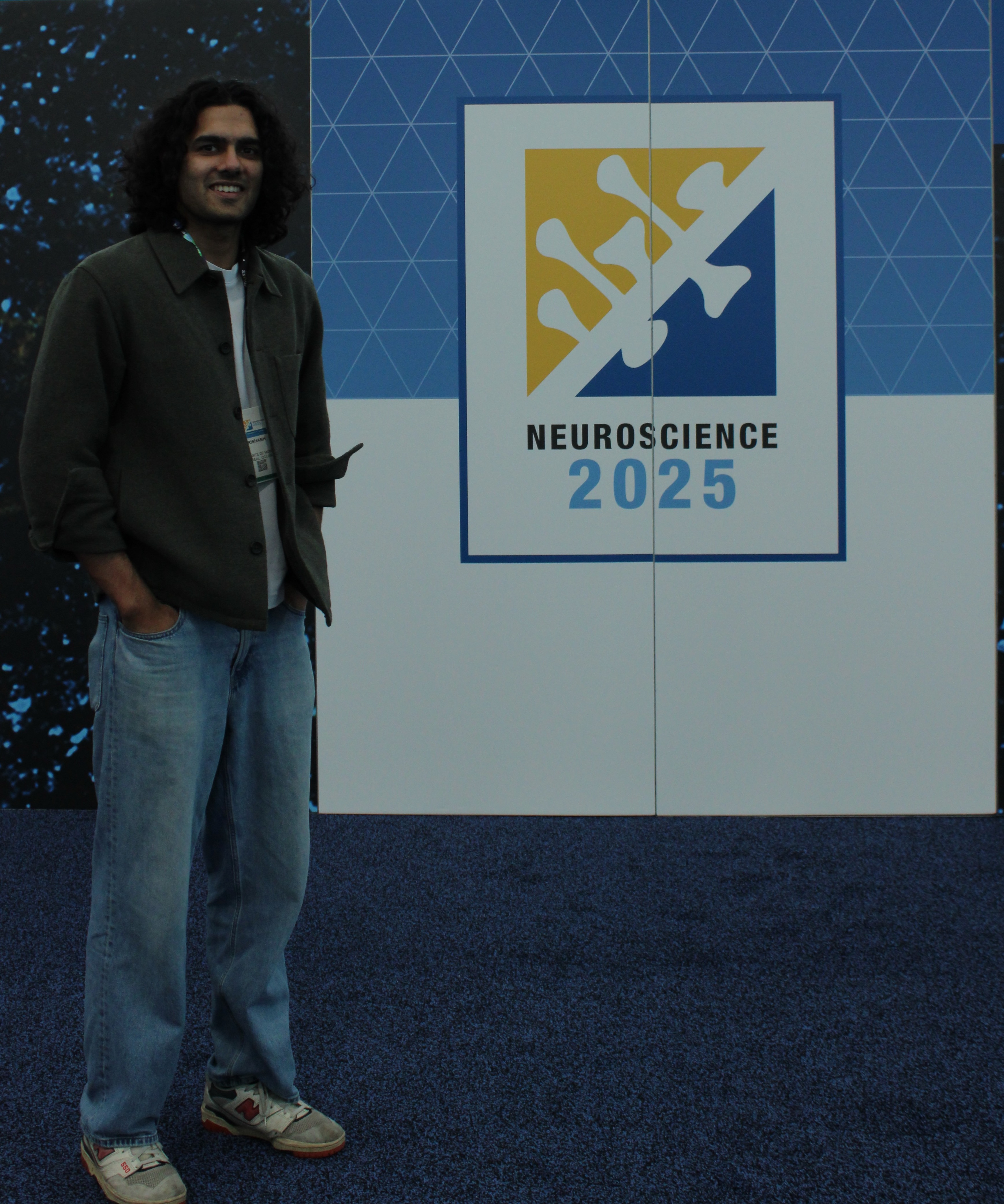 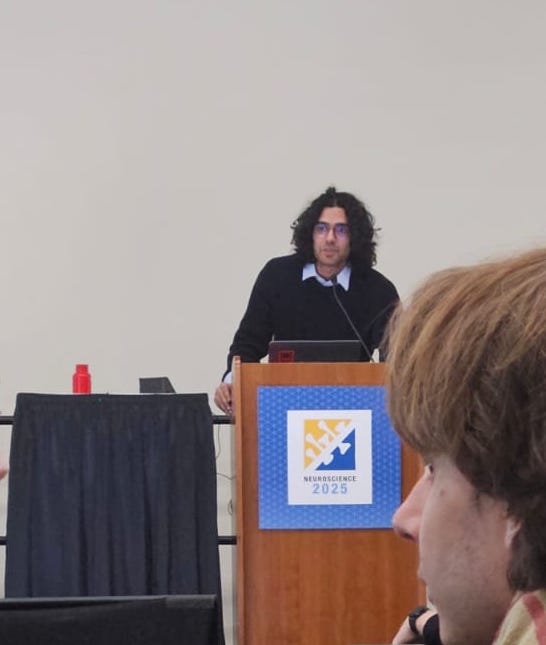 My first scientific talk at world’s biggest neuroscience conference - Society for Neuronscience (SfN) 2025. A lot of amazing scientists from many places came together to showcase their work (including me). In addition, this was my first time organising a symposium at such level thanks to the support of my PI. It was a whelming but worth it experience. |
|---|---|
| Nov 08, 2025 | 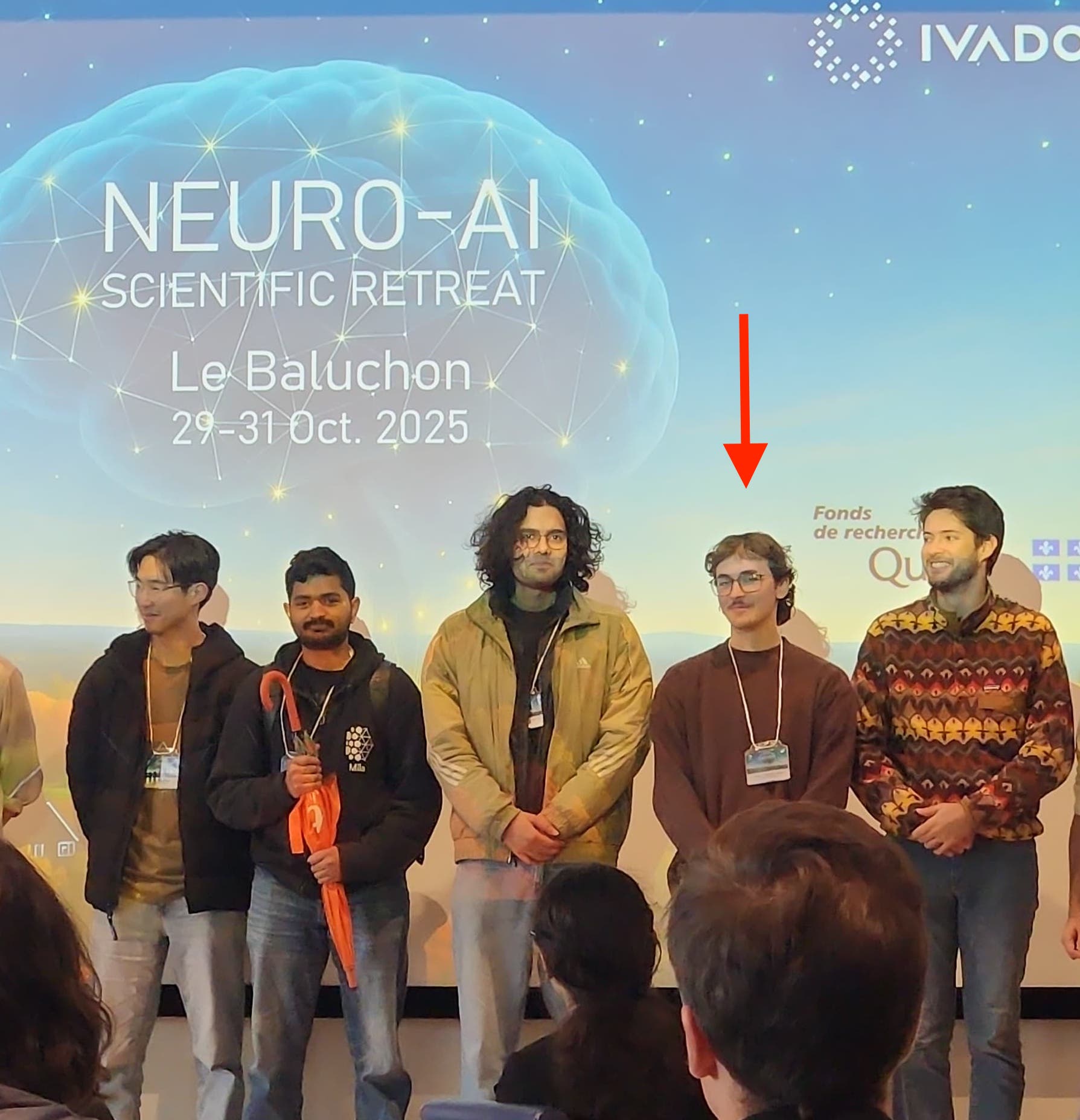 Best PhD poster award at UNIQUE retreat. Congratulations!! 🥳🥳🥳 to my best friend VJ on my left (red arrow) for winning best poster in masters category. It was a lot of fun and learning experience. |